How to Run a Shopify Store in the AI Era: A Practical Guide to Sidekick, AI Agents, and Automation
Shopify ships Sidekick. Your apps ship agents. This report compares the tools by the job each one actually owns, uses public merchant feedback to show where they fall short, and proposes an operating model that keeps risky changes behind your approval.
A Shopify owner’s Tuesday, 7:40 a.m. The Admin shows yesterday’s numbers. Klaviyo wants a review of a new flow. The helpdesk has fourteen open tickets, two of them angry. The ads manager shows one campaign spending fast. A supplier has emailed a CSV of stock levels, again. Sidekick sits in the corner of the Admin, ready to answer questions. Every one of these tools reports something. None of them says what to do first.
That gap is the actual subject of this article. In 2026 the question for a Shopify merchant is no longer “should I use AI.” Shopify itself ships Sidekick and Magic, and most serious apps in support, marketing, analytics, and automation now ship an agent or an AI feature. The question that matters is how to divide the work: what AI runs on its own, what automation executes, what specialist tools keep, and what waits for the owner.
The short answer
The strongest setup we can defend from public evidence is not any single tool that claims to run the whole store. It is a controlled operating system with four properties:
Shopify stays the system of record. Orders, products, customers, inventory, discounts, and permissions live there and nowhere else.
Specialist tools keep their domains. Klaviyo does lifecycle marketing better than a general agent will. Same for Gorgias in support, Lifetimely in profit analysis, Intelligems in experiments.
One owner-facing priority queue. Somewhere, the signals from all of these tools get merged, deduplicated, and ranked into a single answer to “what matters today.”
Risk-based approval. Reading and drafting can be delegated broadly. Anything that touches prices, refunds, budgets, or customer-visible content waits for a person.
The rest of this article is the evidence for that claim: what each tool category actually does, what merchants say in public when it falls short, and how to sequence adoption without betting the store.
AI is most useful when it turns scattered signals into a short queue, then pauses for the owner before anything consequential changes.
The tool categories, by the job they own
Comparing “Shopify AI tools” head to head is mostly a category error. Sidekick and Mechanic are not competitors; they do different jobs. The useful comparison groups tools by the merchant job each one owns:
Native store copilot: Sidekick and Magic, built into the Admin.
Cross-channel analytics and decision agents: Polar Analytics, Triple Whale.
Financial intelligence: Lifetimely.
Customer service agents: Gorgias, Yuma, Siena.
Lifecycle marketing: Klaviyo.
CRO and personalization: Intelligems, Rebuy.
Workflow execution: Shopify Flow, Mechanic.
Owner operations layer: an emerging category that ranks work across domains, prepares actions, and governs approval.
A scan-friendly map of the tool landscape
Figures below (prices, ratings, and review counts) were captured on 2026-07-25 from official pages and Shopify App Store listings. They change over time.
A practical map of eight Shopify AI tool categories: choose by the job each tool owns, then set an approval boundary that matches the risk.
A single daily queue with evidence and proposed next actions.
Watch
This is still an emerging category with little long-term public review history.
Approval
Approval is the core operating mechanic, not an afterthought.
Sidekick and Magic: the native copilot
Sidekick’s advantage is structural. It sits inside the Admin with native access to store data and permissions, needs no synchronization, and Shopify’s Spring ’26 Editions materials describe it connecting to apps such as Judge.me, Klaviyo, Loop, and Smile, with Sidekick Pulse proactively suggesting acquisition, conversion, and retention work. For questions about your own store data, content generation, and a growing set of Admin actions, it is the default and it is included in the plan price rather than sold separately.
The public record also shows its current edges. Shopify Flow’s reviews include merchants asking for Sidekick to do more inside Flow, and cases where its guidance did not resolve the workflow problem at hand. And there is still limited public evidence that Sidekick reliably merges advertising, finance, inventory, fulfillment, customer feedback, and external legacy systems into one ranked queue for the owner. It answers what you ask. The morning problem is knowing what to ask first.
Polar Analytics and Triple Whale: decision agents over connected data
Polar Analytics describes 62 AI agents running a read/judge/act model over an ecommerce BI foundation, covering paid growth, site, supply chain, retention, finance, and weekly team work. Each agent has a clear job boundary, which is exactly the design this article argues for. The trade-offs: pricing is demo-based, the product is oriented toward more mature DTC brands, and a catalog of specialist agents can still leave the owner reconciling priorities between them.
Triple Whale’s Moby takes natural-language analysis over connected data and turns conversations into scheduled or triggered automations: management reports, KPI alerts, Meta spend monitoring, Klaviyo triggers, inventory purchase orders. Its pricing runs from a free tier to enterprise, varying by GMV and package. Its historical center of gravity is marketing and attribution, and there is less public evidence of broad Shopify Admin execution across orders, products, and fulfillment than for Sidekick.
Lifetimely: the profit answer
Lifetimely owns a narrow, high-trust job: P&L, net profit, gross margin, LTV, CAC, cohorts, and forecasts, built by combining COGS, ad spend, and order revenue. At research time its App Store listing showed 4.9/5 across 459 reviews, with a free tier at low order volume and an S plan at $79/month for up to 500 orders.
Two limits worth knowing. Public reviews show merchants sometimes needing support to reconcile metric differences between Shopify and Lifetimely, a reminder that any tool computing its own numbers next to Shopify’s will eventually disagree with them and someone has to arbitrate. And it delivers analysis and recommendations, not an operating layer across product, inventory, support, and fulfillment.
Gorgias, Yuma, Siena: customer service agents
Customer support is the most mature AI agent category in ecommerce. Gorgias pairs a helpdesk and unified inbox with an AI agent that gives order-aware responses and performs some service actions; pricing is usage-based, scaling with tickets and AI interactions. Reviews include merchants of three to five years’ tenure who describe the AI agent as valuable. Yuma and Siena cover adjacent ground: shopping assistance, social engagement, reviews, and voice-of-customer work, with customer conversation signals as their raw material.
The risk profile is also the most instructive in this report. A July 2026 Gorgias App Store review reported that an AI agent was incorrectly switched live and replied to customers in off-brand, unhelpful language after an expensive onboarding. That is one merchant’s account, not an established pattern. But the failure mode it describes, an agent speaking to customers before the owner intended it to, is exactly the class of error an approval boundary exists to prevent. Other reviews note the product can do a lot but is hard for nontechnical users to configure. One more boundary matters here: these tools are customer-facing by design. The channel where the owner supervises and approves is a different surface with a different job.
Klaviyo: lifecycle marketing
Klaviyo is the incumbent for Shopify lifecycle marketing: segmentation, flows, and retention automation, with a free tier listed at up to 250 profiles and 500 emails per month and paid pricing scaling by volume. At research time its App Store reviews showed 4.7/5 across 2,911 reviews, with plenty of ROI language from merchants.
Its limit is the same one every strong specialist has. Klaviyo optimizes the CRM and marketing domain, and its AI features help you produce more campaigns and flows. Whether tomorrow’s most important task is a campaign at all is a question it is not built to answer. One community thread makes the customer-side cost concrete: a merchant found their welcome and abandoned-cart automations stacking too many emails onto the same person at once. More automation in one domain, uncoordinated, can degrade the customer experience it is meant to improve.
Intelligems and Rebuy: experiments and onsite revenue
Intelligems runs pricing, promotion, shipping, and checkout experiments, closing the loop from hypothesis to measured outcome, and can optimize profit per visitor rather than only conversion. At research time it showed a $69/month starting price and 4.8/5 across 154 reviews, with higher plans scaling by order volume. Rebuy works the onsite surface itself: recommendations, cart, checkout, and post-purchase revenue, with public plans starting around $25/month.
One piece of review feedback deserves careful handling. A June 2026 one-star review alleged a long setup delay after purchasing a roughly $2,000/month plan, and said a pricing test was started without clear verbal approval. Treat that as a single merchant’s allegation, not established product behavior. The general lesson stands on its own: price, discount, and checkout changes are the highest-risk writes in a store, and any tool touching them should show an explicit diff, a defined scope, an owner sign-off, and a rollback path before anything goes live.
Flow and Mechanic: the execution layer
Shopify Flow is the native trigger/condition/action engine across tags, inventory, orders, notifications, fraud, and apps, with no separate subscription fee and, at research time, 4.7/5 across 11,326 reviews. Mechanic is the power-user counterpart: 355+ prebuilt automations plus custom Liquid/API tasks, listed at $16/month (Basic Shopify) and $29/month (Grow), with a 5.0/5 rating across 126 reviews and merchants reporting it replaced several single-purpose apps.
The public complaints about Flow are a map of where execution engines stop helping: complex UI, difficulty testing, slow or crashing complex flows, occasional missed triggers, save failures that lose editing progress, and missing native actions such as some transactional-email cases. Mechanic’s advanced work usually needs Liquid or API knowledge. Both tools share one deeper limit: they execute rules a person already wrote. Identifying the opportunity, expressing the rule, testing it, and noticing when it silently fails all remain human work.
What merchants actually complain about
Product pages tell you what tools intend. Community threads tell you what merchants still do by hand. Six patterns recur across the Shopify Community:
Rules merchants can say but not build. A merchant wanted repeat-order discounts applied automatically by order count; native conditions could not directly express the rule. Merchants can state their business logic in a sentence. Translating it into Flow triggers, APIs, Liquid, or JavaScript is where it dies.
Product data too messy to fix by hand. A third-party inventory sync dropped Age, Gender, Color and other metadata, and bulk editing was too slow at the merchant’s volume. This is genuinely AI-suitable work, with a condition: infer fields from source data, flag conflicts, preview everything, mark low-confidence rows, and write only after review.
Fraud losses that pattern-matching missed. Two orders Shopify marked low-risk led to about $1,500 in losses. A customer received multiple orders and then filed repeated chargebacks. A partial refund was followed by a chargeback for the full amount. The safe AI job here is collecting evidence, organizing deadlines, spotting anomalous combinations, and drafting the response. Cancelling, refunding, or contacting the customer stays with the owner.
An operating model for AI-era Shopify operations
The complaints above are not tool failures so much as architecture failures: signals with no ranking, writes with no approval, rules with no author. Here is the model we would run instead, in five layers.
Layer 1: Shopify is the system of record. Orders, products, customers, inventory, fulfillment, discounts, and permissions stay authoritative in Shopify. Every other tool reads from it and, when allowed, writes back to it. Never the reverse.
Layer 2: Specialist tools keep their depth. Klaviyo for lifecycle marketing, Gorgias for support, Lifetimely for financial analysis, Intelligems for experiments, Flow and Mechanic for execution. Replacing a strong specialist with a general agent trades proven depth for promised breadth.
Layer 3: One owner-facing priority queue. A single daily view that merges sales and traffic changes, unfulfilled and missing-tracking orders, inventory risk, returns and chargebacks, repeated customer questions, marketing conflicts, product-data gaps, and actions waiting for approval. For each item it should answer six questions: What changed? Why does it matter now? What evidence supports the recommendation? What action is proposed? Who must approve it? How will completion be verified? Whether a person or an agent assembles this queue matters less than the queue existing.
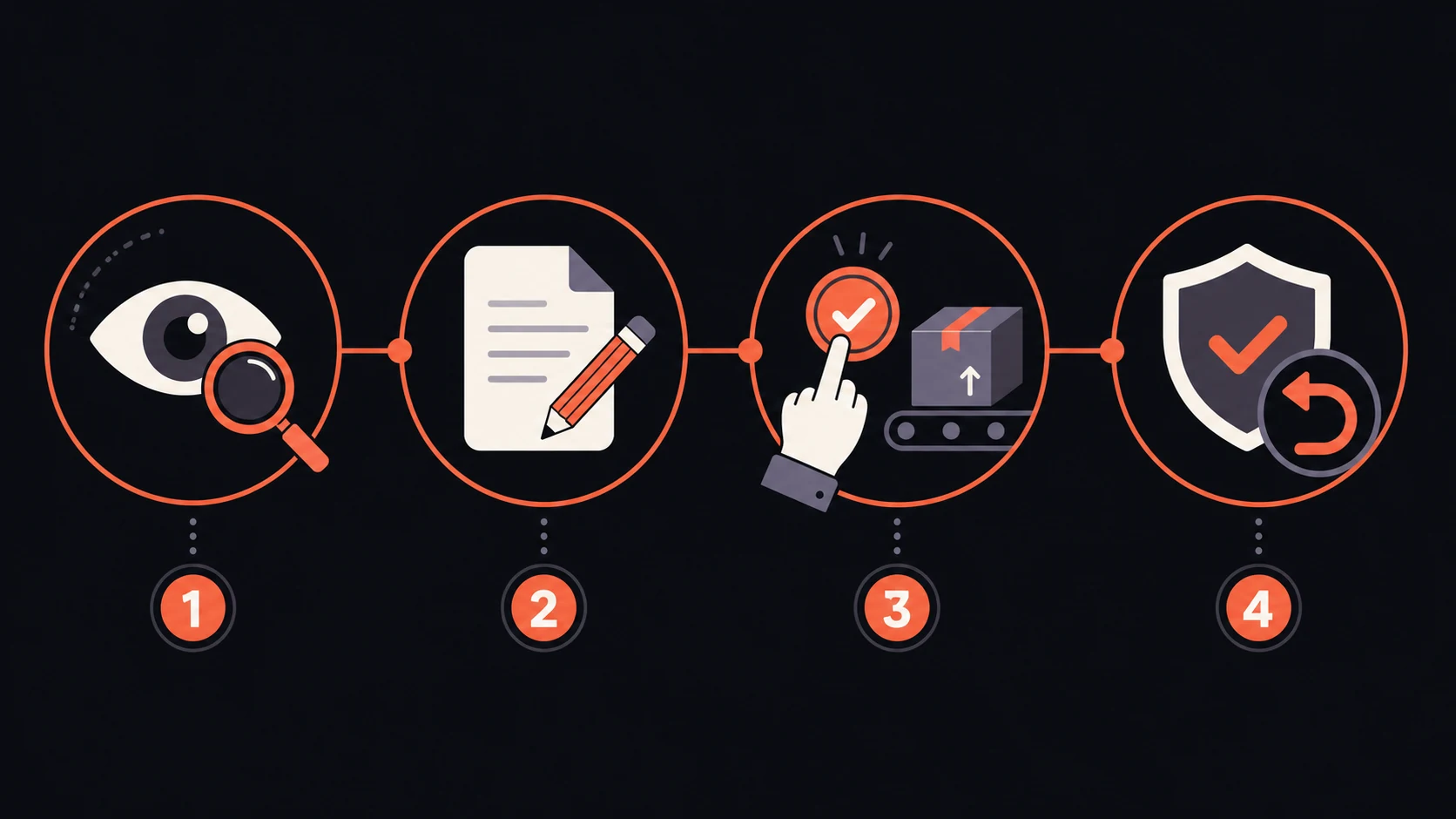
Layer 4: Risk-based approval. Four levels cover almost everything:
Move from observation to execution gradually. The more visible or expensive the action, the stronger the approval and rollback requirement.
Draft: emails, product-field changes, refund proposals, workflow drafts. Delegate the drafting, review the output.
Approve then execute: sending messages, modifying inventory, publishing product changes, creating discounts. Nothing moves without a sign-off.
Strict approval and rollback: pricing, large refunds, ad budgets, bulk changes, purchases, broad customer communication, tax and payment settings. Sign-off plus a tested way back.
Layer 5: Verify outcomes. After any action, capture what changed, the object IDs and timestamps, whether the workflow succeeded, the result against the expected metric, and the rollback information. The Flow reviews complaining about silently missed triggers show what happens when this layer is skipped: automation you trust more than you monitor.
A three-week adoption sequence
You do not need to adopt this model in one move, and you should not.
Week 1: read-only daily brief. Wire your existing tools (or an agent, or a spreadsheet) into one morning summary. No writes at all. The goal is to learn whether the ranking matches your judgment.
Week 2: draft actions. Let the system draft replies, product-field fixes, and workflow proposals. You still send, apply, and publish everything yourself. Now you are grading its drafts.
Week 3 and on: approval-based execution. Allow execution for the categories where drafts have been consistently right, always behind an explicit approve step, starting with the lowest-risk writes.
If a tool cannot operate in read-only or draft mode for its first weeks, that is a signal about the tool.
Which setup fits your store
Solo operator with a relatively simple app stack. Sidekick plus Flow covers a lot at no extra cost. Add a manual daily brief before adding anything else.
Small team, support volume growing. Add a support agent (Gorgias, Yuma, or Siena) with auto-reply limited to intents you have reviewed, everything else in draft mode.
Margin uncertainty, real ad spend. Add Lifetimely for the profit view, and expect to arbitrate occasional metric differences with Shopify’s own numbers.
Growth team running paid channels. Polar Analytics or Triple Whale, with the understanding that someone still merges their outputs into one priority list.
Complex rules, developer access. Mechanic, with tasks under version control and someone owning failure monitoring.
Several of the above already installed. Your gap is probably not another specialist. It is the priority queue and the approval boundary, whether you build that as a routine, a spreadsheet, or an owner-facing operations agent.
Methodology and limitations
Research cutoff was 2026-07-25. Sources were official product and pricing pages, Shopify App Store listings and reviews, and public Shopify Community threads. Prices, ratings, and review counts were captured on that date and change frequently; check current pages before purchasing. Individual reviews, including the Gorgias and Intelligems incidents described above, are single merchants’ public accounts and are labeled as such. We did not run paid head-to-head trials of every product, and App Store search-result volume was not treated as a count of competitors. Community threads were selected for how clearly they state a recurring need, not as a statistical sample of all merchants.
FAQ
Is Sidekick enough on its own?
For store questions, content, and a growing set of Admin actions, it is the obvious default and costs nothing extra. The public record does not yet show it merging ads, finance, inventory, and external systems into one ranked daily queue, so most operating stores still need the priority layer from somewhere else, even if that is a human routine.
Should I replace my specialist apps with one AI tool?
The evidence points the other way. Specialists hold real depth (Klaviyo’s segmentation, Gorgias’s support workflows, Lifetimely’s P&L), and the recurring merchant complaints are about coordination between tools, not about any one tool lacking AI.
Can I let an agent change prices or send refunds automatically?
Our reading of the community evidence says no. The costliest public incidents in this report involve writes that customers could see. Keep pricing, refunds, budgets, and bulk changes at the strictest approval level, with rollback prepared before execution.
What should I automate first?
A read-only daily brief. It carries zero write risk, it tests whether the system’s ranking matches your judgment, and the merchant threads asking for exactly this suggest it is the highest-value single artifact in store operations.
How do I evaluate a Shopify AI app before connecting it?
Read the newest reviews first, including the one-star ones, and look for how the vendor handles them. Then ask three questions: can it run read-only for two weeks, does every write show a preview and an approve step, and is there a rollback path for the changes it makes.
A note on what we build
ClawMama builds an owner-facing operations Agent for Shopify stores: it reads store signals, ranks the day’s work into the kind of priority queue described in Layer 3, drafts actions, and asks for your approval in the chat app where you already work. It is the Layer 3 and Layer 4 of this model, offered as a product; it does not replace Shopify, Sidekick, your support desk, or your specialist apps. If that is the gap in your stack, the Shopify Growth Operator Agent is where to look, and the Skills are public on GitHub. If not, the model above works fine with a spreadsheet and a disciplined morning.